Is It A Language Disorder Or Something Else?
What is a Language Disorder?
Similar to speech disorders, language difficulty is also known by many names:
- language delay
- language disability
- language impairment
- specific language impairment
Between 6 and 8 million people in the United States have some kind of language impairment. This includes adults with acquired language problems from things like brain injuries and strokes.
About 1 in every 20 children has symptoms of language impairment.
Children with language disorders do not understand and/or produce language (spoken and/or written) at the expected age levels.
A Receptive Language Disorder is when a child has difficulty understanding language. They have trouble comprehending when they listen or read.
Problems with receptive language skills usually begin before age 4.
An Expressive Language Disorder is when a child has difficulty talking or expressing his/her ideas.
This difficulty in talking is not because of "how" they are speaking or saying the sounds (articulation), but because of "what" they are saying (form, content, and function).
Children can have a receptive language delay, an expressive language delay, or both. A typical rule of thumb is that you comprehend more than you can speak.
If you have ever learned a second language then you know what I am talking about. I took 4 years of Spanish in high school.
Even though I can hardly speak Spanish, I can still understand quite a bit.
You could say I have a Spanish "expressive language delay!"
It is difficult to generalize about children with language disorders because every child is different.
But a child with a language disorder may have some of the following problems:
- Started talking late
- Has a hard time following and/or giving directions
- Understanding questions is difficult (Example: Can't answer questions like
who, what, where, when, why) - Difficulty understanding jokes, double meanings, and abstract concepts
- Spoken language is simpler than their peers
- Limited vocabulary
- Incorrect grammar such as problems with pronouns (his/her), tense (goed/went), or plurals (mouses/mice)
- Has difficulty remembering words, including everyday ones like words in songs, nursery rhymes, days of the week, and people's names
- Uses non-specific words such as "stuff, thing" a lot
- Tells and writes stories that are disjointed (not connected well) and
missing details - Has trouble breaking language into its parts (Example: finding words in sentences or sounds in words)
- Has a hard time with social skills like taking turns, staying on topic, or saying when they don't understand
- Does not start conversations very often, quiet and less talkative than peers
- Phonological Awareness skills are weak
Language difficulty may not always be obvious!
SEE ALSO: The Best Free App for Speech Therapy


It can be hiding behind many other problems that often make the child look like they are just a "behavior problem", or that they need "more discipline", or they need an "attitude" change!
Many children get labeled this way without knowing the problem behind it.
On the flip side though, many children with language disorders become "trouble-makers" in class because they are off-task, distracting others, bullying, being silly, lacking help, and struggling to succeed.
Here are some of the behaviors often mistaken for a "bad student" or a "not trying student" that can indicate an underlying language impairment:
- Gets distracted easily
- Slower to answer questions
- Slower to put thoughts together to express their ideas
- Slower to follow directions (Example: When 2-3 instructions are given, they are still processing the first instruction so they automatically miss the next instruction)
- Does not plan well
- Difficulty predicting and inferring or guessing what happened and what will happen next
- Has a hard time reading so the meaning is usually missed
- Disorganized behavior and "tuned off"
- School performance is weak and has lots of gaps
- Has a hard time listening in background noise
- Lacks permanence in skills and knowledge (Example: Knows something one day but doesn't know it the next day)
- Doesn't transfer skills (Example: Can do something in one subject but not another)
- Relies on familiar things and routines, likes to stay in his/her comfort zone
What is Language?
Language is a code that we learn to use in order to communicate ideas and express our wants and needs.
Reading, writing, speaking, and gestures/facial expressions are all forms of language.
The language code is made up of rules that we all share and must follow to communicate well. There are rules for:
- Creating words from smaller units like sounds, letters
- Modifying the meaning of root words (Example: girl + s = girls, walk + ed = walked, teach + er = teacher, big + est= biggest)
- Combining words together in order for the correct meaning (Example: "I went to the store" not "I store to the went")
- Holding a conversation (Example: looking at the speaker, taking turns talking, etc.)
- Telling stories (Example: introduction, character, settings, sequential order)
- Using different forms of language for different purpose, listeners, and situations (Example: Saying "Could you help me please?" vs. "Help me!" when you need quicker help)
We just have to learn the vocabulary and follow the rules.
Language rules are categorized into 3 major areas:
- Form
Phonology - is the rules for putting individual sounds together to make words such as spelling rules.
Morphology - is the smallest meanings of words. For example: "ed" on the end of a word means it happened already, "ing" means it is happening right now.
Syntax - is how words are arranged in order to make meaningful sentences. Grammar is a part of this. - Content
Semantics - is the meaning behind words in our language. A large vocabulary helps us communicate better. - Function
Pragmatics - is how we combine all the above parts of language to communicate appropriately in social situations. We all need social skills to succeed.
Some children have deficits in all of them and others can develop language normally but have gaps or holes.
That is why it is important to have a certified Speech-Language Pathologist complete a full evaluation to identify all the skills that are impaired.
SEE ALSO: The Best Books for Speech Therapy Practice

What Causes It?
Most children begin developing language naturally at birth. Hearing, seeing, understanding, and remembering are all skills that are necessary for learning language.
Children also need to be able to form speech physically.
Despite having all of these abilities, some children don't acquire language normally.
With delayed language, the child develops speech and language in the same way as other children, but later than expected.
With language disorders, speech and language do not develop normally. The child may have some language skills, but not others. Or the way the skills develop is different than usual.
Most of the time, the causes of language problems are unknown and is called a developmental language disorder.
Some of the known causes include:
- Hearing loss
- Neurological disorders
- Brain injury such as head trauma or stroke
- Mental retardation
- Drug abuse
- Syndrome
- Autism
What does it affect?
What an SLP does to help?
What can I do about it?

Freebies, Activities, and Specials, Oh My!
Sign up for Terrific Therapy Activity Emails
Your information is 100% private & never shared.

Hi! We're Luke and Hollie.
We are both MS CCC-SLPs and fell in love while studying for our degrees. Since then we have done everything together - graduated, worked, and started a family. We spend most of our time with our family and the rest making this site for you.
Top Free
Resources



Free Apps
Word Vault Essential

# 1 Chronological Age Calculator

Popular Materials
All in One Printable Flashcards
Multiple Meaning Word Mega Pack
Complete Articulation Word Search
New! 111 Articulation Stories
Teaching the Sound Books

Multi-Syllabic Words Flashcards
Apps to Save You Time
& Help Your Clients
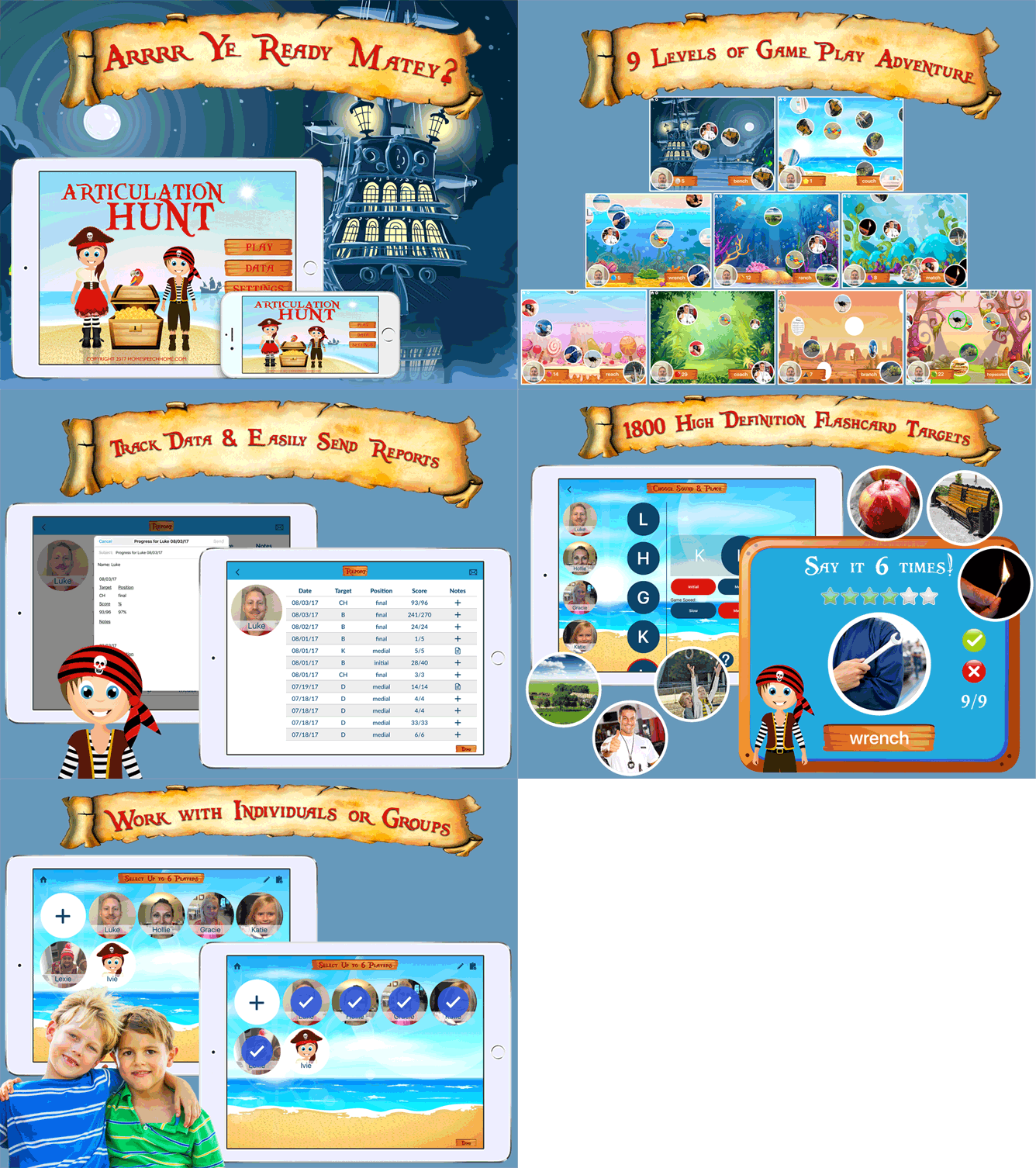
Articulation Therapy + Pirate Adventures = Awesomeness!

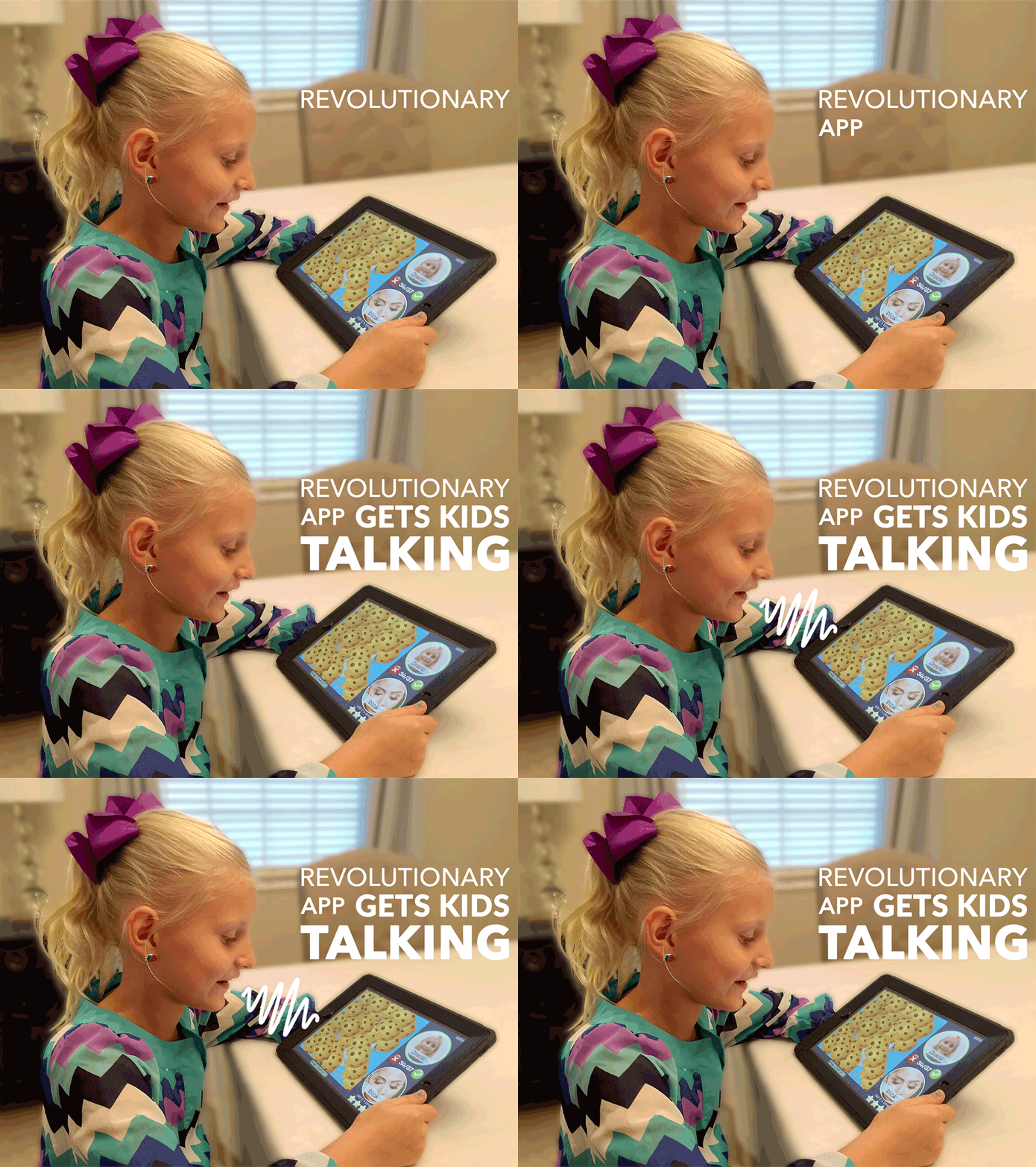
This App Will Get Your Kids Talking






Copyright © 2010 –
HomeSpeechHome.com | All Rights Reserved
This website contains affiliate links, meaning if you buy something from them we may make some money (at no cost to you).
By using our affiliate links, you are helping to support our site which is a U.S.-based, family-run small business :)