Dysphagia: The Essentials
Dysphagia is...
The technical term for a swallowing disorder or swallowing difficulty.
Pronounced "dis-fay-juh", it has also been spelled "dysphasia" but the official spelling is with a "g" not an "s".
On average people swallow about 580 times a day.
Explore Our Goal Reaching, Client Centered Products
What is a Swallowing Disorder?
It is defined as difficulty in swallowing, the inability to swallow, or a condition in which swallowing is difficult or painful.
There are 4 phases of swallowing:
- Oral Preparatory Phase - food is chewed and manipulated in the mouth
- Oral Phase - the tongue moves to push food toward the back of the throat to "trigger" the swallow
- Pharyngeal Phase - after the swallow is triggered, the food (also known as a bolus) moves down the upper portion of the throat known as the pharynx
- Esophageal phase - the food moves past the pharynx and enters the esophagus where it moves further down into the stomach
A person with a swallowing disorder has a problem at one or more of these phases.
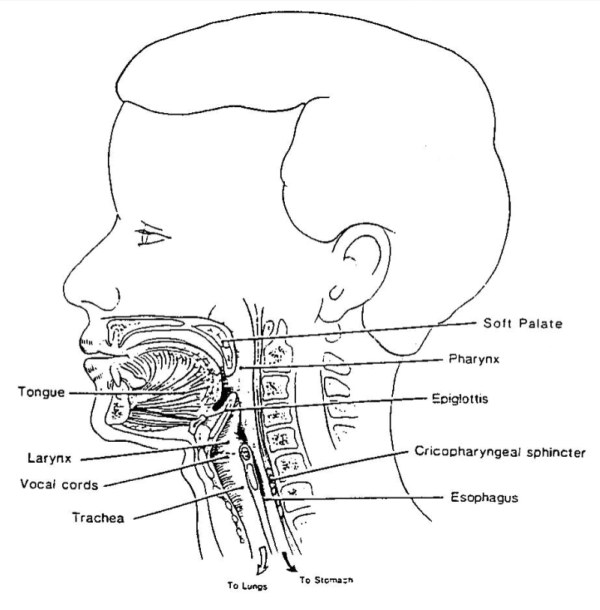
We have 2 "tubes" in our throat. One "tube" known as the trachea (or airway), is where air goes in and out of our lungs and past our vocal cords.
The other "tube" known as the esophagus, is where food and liquid go down into the stomach.
Penetration is when food or liquid goes into the trachea and stays above the vocal cords.
Aspiration is when food or liquid goes into the trachea and goes below the vocal cords.
Both of these are "undelightful" to experience.
If you have ever breathed in with food or liquid in your mouth, you know what I'm talking about.
You probably coughed uncontrollably. Your face turned red, your eyes watered, and when people asked if you were alright, you might have said...
...it went down the wrong pipe.
Coughing is the body's way of getting food, liquid, and any other object out of the airway. It also keeps things from going into the lungs.
Coughing is a good thing because that means the body feels something go into the airway.
The problem comes when a person has food or liquid go into their airway...
...and they don't feel it.
This is called silent aspiration.
The only way this can be detected is through imaging studies such as a modified barium swallow study or MBS (see details below).
There are many signs and symptoms of swallowing difficulty or dysphagia.
SEE ALSO: The Best Free App for Speech Therapy


Some are:
- Inability to recognize food
- Difficulty placing food in the mouth
- Inability to control food or saliva in the mouth
- Coughing before, during, or after a swallow
- Frequent coughing at the end of a meal or right after
- Weight loss when no other reason can be defined
- Wet vocal quality (speech sounds gurgly)
- Pneumonia
- Malnutrition
- Dehydration
What Can I Do About It?
The best thing you can do if you or someone you care for has dysphagia, is to follow the advice of the Speech Pathologist who treats you.
When necessary they will recommend a specific diet to follow.
Follow it...it's for your safety!
As a hospital intern I remember observing a patient of mine who was not supposed to eat anything, in medical terms this is called NPO (nothing by mouth or "nil per os" in Latin)
I walked into his room one afternoon to see him lying on his back eating a cheeseburger.
My supervisor and I were speechless and she was very upset with him
If you want to...
- spend more time in the hospital
- increase your chances of pneumonia
- improve your chances of dying
...by all means, don't follow the diet recommendation.
SEE ALSO: The Best Books for Speech Therapy Practice

The SLP may give you exercises and other suggestions. Practice your exercises as often as possible and follow the suggestions for eating.
Some examples of eating suggestions may be:
- person should be well rested
- sip don't pour liquids into the mouth
- remove distractions (if person is easily distracted)
- person should be seated upright at a 70-90 degree angle
- encourage the person to chew well before swallowing
- encourage the person not to talk while eating
Additionally, there are a variety of techniques an SLP can give someone with dysphagia that will be specific to what problem(s) they are having, such as:
- a chin tuck
- head turn toward weak side of the body
- re-swallow
An SLP should discuss these with you and help you use them at home.
Resources We Like
The Merck Manuals Online Medical Library

Freebies, Activities, and Specials, Oh My!
Sign up for Terrific Therapy Activity Emails
Your information is 100% private & never shared.

Hi! We're Luke and Hollie.
We are both MS CCC-SLPs and fell in love while studying for our degrees. Since then we have done everything together - graduated, worked, and started a family. We spend most of our time with our family and the rest making this site for you.
Top Free
Resources




Free Apps
Word Vault Essential

# 1 Chronological Age Calculator

Popular Materials
All in One Printable Flashcards
Multiple Meaning Word Mega Pack

Complete Articulation Word Search

New! 111 Articulation Stories

Teaching the Sound Books
Multi-Syllabic Words Flashcards

Apps to Save You Time
& Help Your Clients
Articulation Therapy + Pirate Adventures = Awesomeness!


This App Will Get Your Kids Talking






Copyright © 2010 –
HomeSpeechHome.com | All Rights Reserved
This website contains affiliate links, meaning if you buy something from them we may make some money (at no cost to you).
By using our affiliate links, you are helping to support our site which is a U.S.-based, family-run small business :)